


When filings unsealed in January 2026 copyright lawsuit against Anthropic revealed an internal plan to “destructively scan all the books in the world,” just about everyone on the internet wondered whether the bookless future predicted in dystopian works of science fiction like Fahrenheit 451 would arrive not as piles of books stacked high and torched in some far-off authoritarian regime, but as the mundane expansion of AI training datasets in warehouses across America.
Anthropic called this pursuit “Project Panama,” a program to quietly spend millions on books, slice off their spines with hydraulic cutters, scan their pages, and discard the husks of human knowledge in a quest for new and better training data to help AI learn “how to write well” instead of spewing “low-quality internet speak.” “We don’t want it to be known that we are working on this,” read the memo.
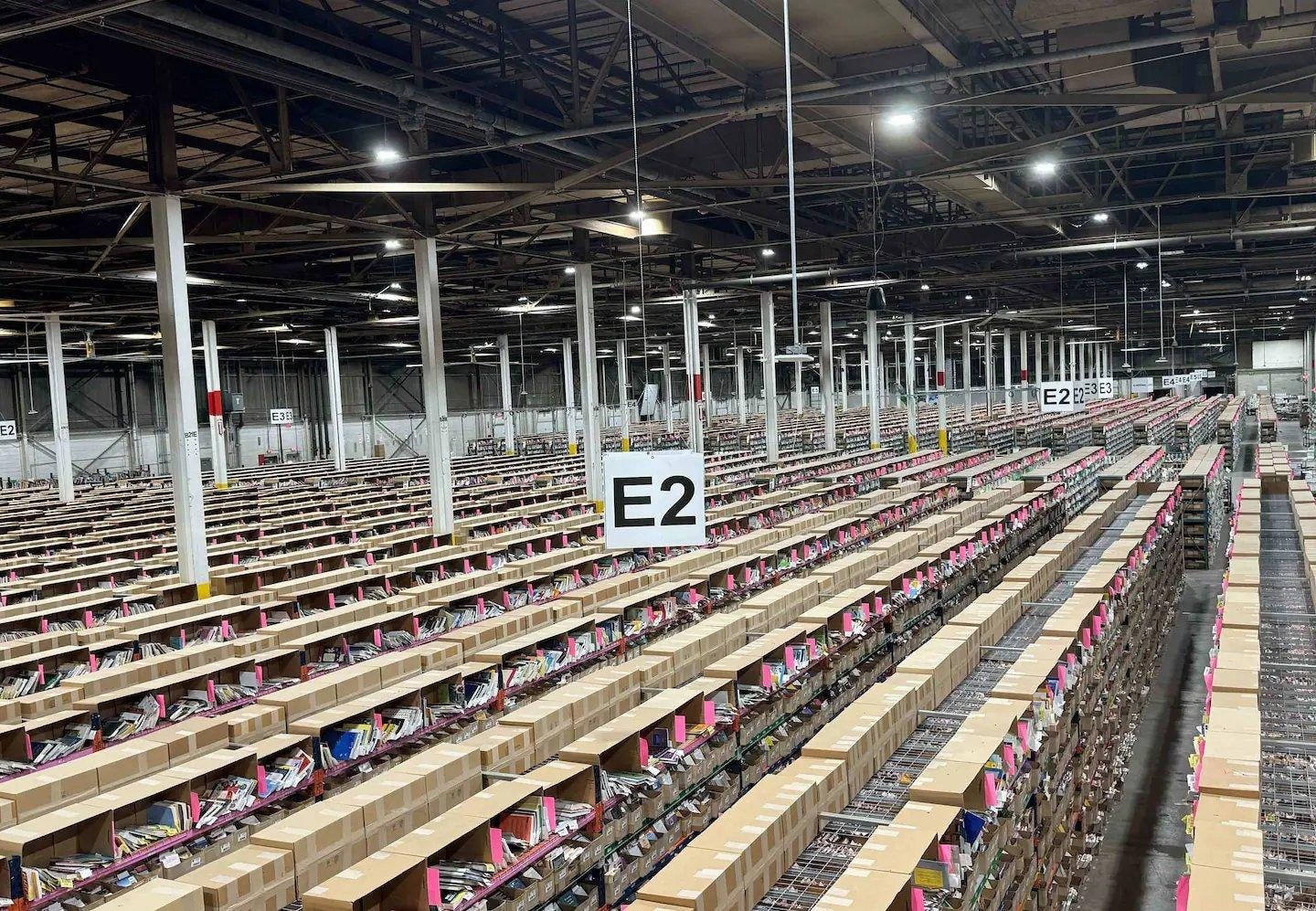
A window into a book warehouse that was alleged to play a role in Anthropic’s Project Panama, disclosed in January 2026 court proceedings, and obtained by The Post
The revelation of Anthropic’s plan to scan “all the books in the world,” and reporting on similar processes unfolding across the industry, led to a predictable sequence of sensationalist commentary and righteous condemnation: Anthropic was “brutally murdering” books; companies scanned books to “steal the information and then essentially sell it back to you”; one post on X with 18 million views lamented the “sum of human thought, digitized and shredded,” while another worried that the process was “irreversible.”
Concerns went viral enough that Elon Musk himself replied on X: “I’ve asked the SpaceXAI team to preserve any rare books in a library and scan them the hard way vs just cutting off the spine and scanning.”
But as The New Yorker’s Francesca Mancino explains in a thoughtful essay, there is seemingly little substance to the critiques. The lawsuit that surfaced the Project Panama memo, Bartz v. Anthropic, had already settled this point. In June 2025, Judge William Alsup defined the destructive scanning of lawfully purchased books as a classic case of fair use. (The $1.5 billion Anthropic later paid to settle the case covered the seven million pirated books it had downloaded to train its models, not the ones it bought and cut apart.) Alsup wrote:
“Authors cannot rightly exclude anyone from using their works for training or learning. [...] Everyone reads texts, too, then writes new texts. They may need to pay for getting their hands on a text in the first instance. But to make anyone pay specifically for the use of a book each time they read it, each time they recall it from memory, each time they later draw upon it when writing new things in new ways would be unthinkable.”
Melanie Walsh, an assistant professor in the Information School at the University of Washington who spoke to Mancino on the record, even suggested that “there’s an argument to be made that these obscure academic books may make a bigger impact as part of a Claude model than they would otherwise.”
Millions of books are made and destroyed all the time
The irony of the present spine-slicing panic is that libraries, special collections, and booksellers regularly discard titles they can no longer use or sell. As the academic librarian Claire Sewell put it on Medium, “old, outdated, damaged, or simply low circulating books have to be weeded on a regular basis in order for us to make space for new books that you’ll actually want to check out.” Weeding a collection is part of curating knowledge, a set of active choices about which titles to keep, and why. Two decades ago, Matthew Battles, then a Harvard librarian, wrote that “major libraries everywhere are hemorrhaging books by the heap, selling them, pulping them, or storing them in remote warehouses by the millions of volumes.”1
Americans have panicked about the supposed death knell of books before. A quarter century ago, the novelist Nicholson Baker’s Double Fold: Libraries and the Assault on Paper documented the routine library practices that guillotined bound newspapers for microfilming, sent original copies to auction, and consigned countless books to the paper mill. In the preface, Baker recounted how publishing an essay on the disposal of card catalogs turned him into a kind of confessor for concerned librarians:
as a result, librarians at the San Francisco Public Library thought of me two years later when they wanted to tell someone what had happened in their institution: administrators had sent a few hundred thousand books to a landfill after they discovered that a new library building was too small to hold them.2
Given the steady and longstanding practice of junking books, just maybe one copy of Slow Wine 2012: A Year in the Life of Italy’s Vineyards is better served contributing to AI training than collecting dust in a bookseller’s basement in Idaho.
Watching the brouhaha over AI’s appetite for rare text, I kept flashing back to my high school side hustle. From the time I got my license at 16 until the middle of graduate school, I bought tens of thousands of books from estate and library sales and resold them on Amazon. I started out driving my mom’s Ford minivan to large library sales in the Cleveland area, incredible deals on paperback and hardback books on the last day. At some sales I could fill a medium-sized cardboard box with 40 books and pay $5. Whatever was left over went to a landfill or the recycler. I did my part in the salvage: I’d haul a minivan full of boxes home, 500 to 600 books at a time, keep a few (sometimes a few dozen) for myself, and then painstakingly check each ISBN on Amazon for potential sale prices. If I could get more than $7.50, I’d list the book. Rare textbooks or first editions could fetch $50 to $100, but that usually meant holding onto the title for some ungodly amount of time. Almost always, 60 to 70 percent of a haul wasn’t worth listing. I’d pack them back up and drop them off at the nearest resale shop for Project Learn, an adult literacy nonprofit in northeast Ohio. If they couldn’t make use of the titles, they would be sent to Goodwill, recycling, or the landfill.
In short, our society is constantly churning through physical books. Those panicking about a few million books scanned and destroyed in the summer of 2026 seemed totally unaware of the routine practices of “weeding,” donating, and scrapping that make up collection management for booksellers and libraries alike. Most of the books in question are not especially rare or valuable. One-of-a-kind first editions and antiquarian titles that are unique and valuable, as the Antiquarian Booksellers’ Association of America told Mancino, have not been sold to AI companies.
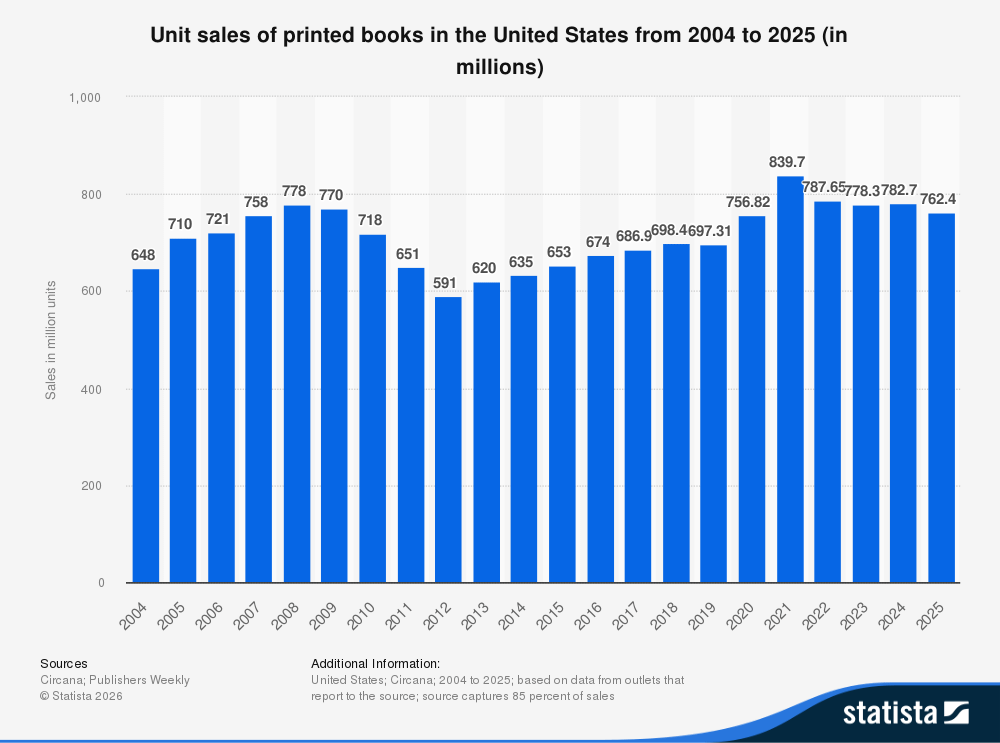
Unit sales of printed books in the U.S., 2004-2025, https://www.statista.com/statistics/422595/print-book-sales-usa/.
Beyond the mundane destruction of books, the fretting over AI scanning might be calmed by some perspective on the stupendous volume of publishing in the modern U.S.: over 4 million books were published in the U.S. in 2025, and roughly 762.4 million printed books were sold–just in 2025. From 2004 to 2025, about 15.7 billion printed books were sold in the U.S., not to mention the steadily growing demand for e-books in the U.S. and abroad.
Book destruction is also not a modern vice. When Henry VIII dissolved the monasteries, the abbeys’ new owners sold their manuscripts as pulp for the bindings of printed books. This led to a later discovery of the only surviving text in Old Saxon in the stiffening binding of a volume in the Vatican Library. In 1068, a Cairo vizier sold 25 camel-loads of books to pay his army. When his Turkish adversaries defeated him, they stripped the leather bindings to make shoes and buried the pages outside Cairo at a spot known for generations as “the Hill of Books.”3
The Library of Alexandria, meanwhile, was almost certainly not burned in a night. Its scrolls met a much less catastrophic demise: they faded into history through neglect and administrative turmoil, crushed by the wheel of time into insect feed. In Battles’s words, “many, many centuries happened” to the scrolls. But we prefer the arsonist because, as Battles puts it, “only catastrophe can provide the drama that acts as a drug against the existential horror of decadence and decline.”4
It may be much easier to hyper ourselves into seeing the hydraulic cutters in anonymous warehouses as the implements of some dystopian plot, but the intent and scope of what we are witnessing in the AI labs is no different than the season-to-season shifts in a bookseller inventory, the normal process of library deaccessioning, and the predictable churn in a country where three-quarters of a billion books are sold every single year.
Matthew Battles, Library: An Unquiet History (New York: W. W. Norton, 2003), 212.
Nicholson Baker, Double Fold: Libraries and the Assault on Paper (New York: Random House, 2001), viii.
Battles, Library, 12–13, 66.
Battles, Library, 32.
Once I told a mom in some Facebook group just to recycle the books she was trying to declutter/rehome, everyone absolutely lost their shit at me!!! They were convinced that some library or Goodwill or collector would just be dying to own their random basement garbage paper. I tried to tell them that libraries are constantly purging but no one believed me.